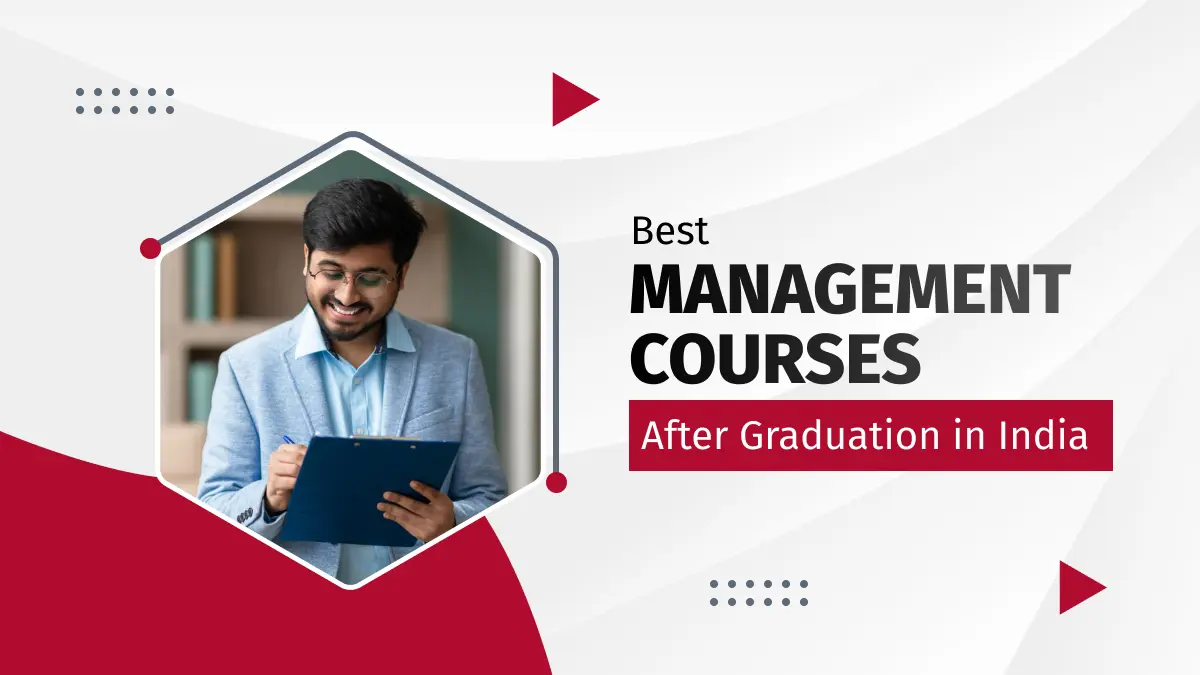
Best Management Courses After Graduation in India
Choosing a suitable course from the available best management courses after graduation in India requires careful comparison of course structure, entrance route, recognition, fees, and career outcome. In 2026, the main options include the MBA, PGDM, one-year executive programmes for experienced professionals, and short online or blended management certifications. The right choice depends on career goal, budget, work experience, and the strength of the institute rather than on the course title alone.
- The main management options after graduation in India are MBA programmes, PGDM programmes, one-year executive management programmes, and shorter online or blended certifications.
- CAT remains the main admission route for many leading Indian business schools, while XAT, GMAT, GRE, NMAT, SNAP, MAT, and CMAT also open important pathways.
- An MBA is a degree. A PGDM is a diploma, usually offered by an autonomous institute. Recognition and academic equivalence should always be checked on official sources.
- Online and blended management learning is now more credible when it comes from recognised institutions with proper teaching, assessment, and academic structure.
This guide lists the best management courses graduates can pursue in India for a satisfying career.
List Of Top Full-Time Management Courses After Graduation In India
Full-time management courses remain the main route for graduates who want classroom learning, peer interaction, internships, and campus placements. The best management courses after graduation in India usually fall into either broad general management or focused specialisation pathways. The right route depends on whether the candidate wants flexibility across roles or a clearer sector direction from the beginning.
MBA/PGDM In Finance
Finance remains one of the strongest management specialisations because it connects directly with banking, lending, treasury, insurance, risk, corporate finance, and financial analysis. In the current market, finance education also overlaps with fintech, compliance, business analysis, and data-backed financial decision-making. Because of this shift, many candidates now compare general finance-oriented MBA or PGDM options with narrower sector routes such as PGDM in Banking, Insurance & Financial Services.
This route is suitable for candidates who want roles in banks, NBFCs, insurance firms, advisory businesses, treasury, financial services, or corporate finance teams. However, salary and role quality vary sharply by institute, recruiter base, and candidate profile. A finance-related title alone does not guarantee a high package.
MBA/PGDM In Marketing
Marketing remains one of the broadest management specialisations because it connects customer demand with business growth. The field now extends beyond traditional brand communication. It includes digital marketing, product communication, pricing, channel strategy, sales management, customer insights, and marketing technology. A strong marketing course should therefore balance theory with live business exposure and practical problem-solving.
This route is suitable for candidates interested in brand management, sales, digital campaigns, product marketing, market research, and customer strategy. It is often preferred by students who want a flexible management specialisation because marketing roles exist across consumer businesses, services, technology, retail, and new-age firms.
MBA/PGDM In Business Analytics Or Data Science
Business Analytics has become one of the most relevant management specialisations because organisations increasingly want managers who can convert data into decisions. That has led to a rise in analytics-centred management courses that combine statistics, business intelligence, machine learning, artificial intelligence, and applied tools. In this space, candidates now compare broad management degrees with focused routes such as PGDM in Big Data Analytics and international analytics pathways such as an International Double Degree in Analytics.
This specialisation is suitable for candidates who are comfortable with numbers, structured problem-solving, and technology-enabled decision-making. Official programme descriptions in this area refer to data management, machine learning, deep learning, business intelligence, and hands-on industry projects. That makes the pathway especially relevant for roles in business analytics, consulting, product analytics, and decision support.
MBA/PGDM In Human Resource Management
Human Resource Management remains an important management pathway for candidates who want to work on the people side of organisations. Modern HR work goes well beyond hiring and payroll. It now covers organisation design, performance systems, learning and development, employee engagement, policy, and business partnering. This makes HRM suitable for candidates who are interested in people processes, organisational behaviour, and leadership systems.
A good HRM course should be checked for curriculum depth, internship opportunities, and recruiter mix. Candidates should also see whether the course develops a practical understanding of workplace systems, labour context, and people analytics rather than only theory.
MBA/PGDM In Healthcare Management
Healthcare Management has become a more visible option because the healthcare sector now needs professionals who understand both business systems and healthcare delivery. This route is suitable for candidates who want management roles in hospitals, pharmaceuticals, healthcare consulting, health technology, medical devices, and allied service organisations. Alongside general MBA or PGDM programmes, some candidates now prefer focused healthcare routes such as PGDM in Health Care Management.
Official programme descriptions in this area show that healthcare management combines business education with sector-specific learning. That makes it suitable for candidates who want a management qualification with a clear healthcare orientation rather than a general programme with only limited healthcare exposure.
MBA/PGDM In Operations And Supply Chain
Operations and supply chain management focus on how organisations plan, produce, move, and deliver efficiently. It includes sourcing, inventory, logistics, quality, service operations, and process design. As businesses become more digital, this area now overlaps with analytics, planning systems, and technology-enabled supply chains.
This route is suitable for candidates interested in manufacturing, e-commerce, procurement, logistics, consulting, and process-oriented roles. It is often a strong fit for students who prefer structured problem-solving, systems thinking, and execution-led work.
List Of 1-Year Executive Management Programmes
One-year management programmes should not be treated as standard options for fresh graduates. In most cases, these programmes are designed for candidates who already have significant work experience and now want faster movement into leadership, consulting, or strategic roles. This is clear from the official eligibility conditions of the leading one-year programmes in India.
Main 1-Year Options
- ISB PGP: A one-year full-time residential management programme. The official programme page requires at least 24 months of work experience, and the official fee page lists a fee of ₹38,67,160 for 2026-27 under the stated conditions.
- IIMA MBA-PGPX: A one-year MBA meant for experienced professionals. The official admissions page states at least four years of work experience, and the official fee page lists ₹35 lakh for single accommodation and ₹37.10 lakh for married student housing for 2026-27, excluding some international immersion travel and stay costs.
- IIM Bangalore EPGP: A one-year residential MBA. The official pages state a minimum of five years of work experience.
- IIM Calcutta MBAEx: A one-year full-time residential programme meant for executives with more than five years of professional experience.
Why The ROI Discussion Is Different Here
The ROI of a one-year executive programme is different from that of a two-year full-time MBA or PGDM because the time away from full-time employment is shorter. That does not make the course cheaper, but it changes the opportunity-cost calculation. These programmes are therefore more relevant for experienced professionals than for fresh graduates.
Best Short-Term And Online Management Certifications You Can Pursue After Graduation
Short-term and online management learning has grown because many candidates want business education without taking a long career break. Official pages from Indian and global institutions show that this market now includes serious faculty-led programmes in leadership, management, analytics, strategy, and business fundamentals rather than only lightweight certificate content.
Common Options In This Segment
- Harvard Business School Online: Offers structured online leadership and management courses.
- eCornell: Offers online certificates in leadership and strategic management.
- Online@IIMA: Offers self-paced and professional online courses across management areas.
- IIMBx: Offers AI and management-oriented courses such as AI for Managers.
- NMIMS Online: Offers online MBA pathways for working professionals.
Who Should Consider This Route
This route is suitable for candidates who want to upskill, strengthen promotion prospects, or build a management base without leaving work. It is usually not a direct substitute for a strong full-time MBA or PGDM when the goal is a major early-career reset. Candidates should always check whether the programme leads to a degree, diploma, or certificate, and whether it includes assessments, faculty-led teaching, and any campus immersion.
How To Choose The Right Management Course And College After Graduation?
The best management courses after graduation in India are not the same for every candidate. A good decision comes from matching course type, career direction, entrance route, fees, and outcomes. Candidates should use a practical filter instead of relying on broad reputation alone.
Step 1: Define The Career End Goal
A general MBA or PGDM suits candidates who want flexibility across business functions. A specialised route suits candidates who already know that they want finance, analytics, healthcare, HR, or operations. This step reduces confusion at the application stage.
Step 2: Assess Budget And Expected ROI
Candidates should compare the official fee with the latest available placement outcomes and the total cost of study. Hostel, deposit, living expenses, and lost income also affect the final decision. A course with moderate fees and stable outcomes may offer better value than a more expensive course with weaker role quality.
Step 3: Evaluate Placement Track Record And Faculty
Placement data should be read carefully. Candidates should look for the batch year, number of companies, number of offers, and whether the report shows average and median salary rather than only the highest package. Faculty should be judged for academic quality and relevance to the specialisation, but placement reporting should remain batch-specific and evidence-based.
Step 4: Consider Geographical Location
Location affects access to internships, live projects, alumni interaction, and recruiter visibility. Candidates often compare institutes in or near major business centres such as Bengaluru, Mumbai, and Gurugram for this reason. Location should not override course fit, but it remains an important practical factor in the final decision.
Conclusion
The best management courses after graduation in India include the two-year MBA, the PGDM, selected specialisation-led routes in finance, analytics, healthcare, HR, and operations, and one-year executive programmes for experienced professionals. Online and blended certificates also have value when the aim is flexible upskilling. The soundest decision comes from checking official eligibility, recognition, fee structure, entrance route, curriculum, and batch-specific outcomes before applying.
FAQs
Which management course after graduation offers the highest salary in India?
There is no single course that guarantees the highest salary across India. Salary depends on institute quality, recruiter mix, role type, prior profile, and market conditions. In practice, strong outcomes are often seen in consulting, finance, analytics, and strategy-linked roles at leading schools.
Is a PGDM equivalent to an MBA in India?
A PGDM is not the same qualification type as an MBA, because one is a diploma and the other is a degree. However, some PGDM programmes are officially recognised by AIU as equivalent to an MBA for academic purposes. Candidates should verify this on the official site.
Can candidates pursue a management course without taking the CAT?
Yes. Candidates can also apply through XAT, GMAT, GRE, NMAT, SNAP, MAT, and CMAT, depending on the institute and the programme.
Which is the best 1-year management course after graduation?
For candidates with the required work experience, widely recognised one-year options include ISB PGP, IIMA MBA-PGPX, IIM Bangalore EPGP, and IIM Calcutta MBAEx. Fresh graduates usually do not meet the eligibility conditions for these programmes.
Are online MBA and management courses worth it?
They can be worthwhile when they come from recognised institutions and match the candidate’s purpose. They are generally more useful for flexibility, promotion support, and skill development than for a full early-career reset.