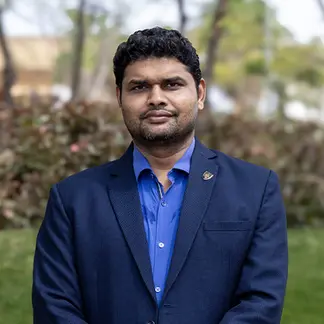
Anup Kumar Maurya
icon
Sports

Cricket, Badminton, Table Tennis

Qualifications:

Ph.D. (Computer Science) - IDRBT (Established by the RBI), University of Hyderabad.
M.Tech. (Artificial Intelligence) - University of Hyderabad.
Former Visiting Research Scholar of the Center for Unified Biometrics and Sensors (CUBS) - State University of New York at Buffalo (SUNY Buffalo), USA.
FDP on Machine Learning with Business Applications - IIM Bangalore.


Areas of Expertise

Artificial Intelligence, Machine Learning, Deep Learning, Generative Artificial Intelligence, Large Language Models, Agentic AI, Data Analytics and Decision Science, Information Security Analytics, Cybersecurity, Internet of Things (IoT), Internet of Vehicles (IoV), Blockchain, Cloud Computing, Federated Learning, Privacy-Preserving AI, and Industry 4.0 Applications.

Anup Kumar Maurya

Profile and History

Dr. Anup Kumar Maurya is currently an Associate Professor in the Big Data Analytics area at the Goa Institute of Management (GIM), Goa. His academic, teaching, and research interests lie at the intersection of Artificial Intelligence, Machine Learning, Deep Learning, Generative AI, Large Language Models, Data Analytics, Cybersecurity, Internet of Things, Internet of Vehicles, Cloud Computing, and emerging digital technologies.

He earned his Ph.D. in Computer Science from the University of Hyderabad for his research titled “Efficient User Authentication and Key Establishment Protocols for Wireless Sensor Networks & Internet of Things.” His doctoral research was undertaken at the Institute for Development and Research in Banking Technology (IDRBT), Hyderabad, an institution established by the Reserve Bank of India.

He holds an M.Tech. in Artificial Intelligence from the University of Hyderabad, a Master of Computer Applications (MCA) from Uttar Pradesh Technical University, Lucknow, and a Bachelor's Degree in Mathematics from Deen Dayal Upadhyaya Gorakhpur University.

Dr. Maurya completed a Faculty Development Program on Machine Learning with Business Applications from the Indian Institute of Management Bangalore (IIM Bangalore). He was also selected as a Visiting Research Scholar at the State University of New York at Buffalo (SUNY Buffalo), USA, where he worked at the Center for Unified Biometrics and Sensors (CUBS) on biometric-based efficient user-authentication mechanisms and security protocols.

His research focuses on developing secure, intelligent, lightweight, and computationally efficient systems using Artificial Intelligence, Machine Learning, and information security techniques. His work spans user authentication and key-establishment protocols, IoT security, the Internet of Vehicles, blockchain-enabled systems, cloud resource optimization, federated learning, cybersecurity analytics, and emerging applications of Generative and Agentic AI.

His recent research interests include secure Agent-to-Agent communication in Agentic AI environments, trustworthy AI, Large Language Models, AI-enabled cybersecurity, autonomous systems, privacy-preserving machine learning, quantum security analytics, and intelligent attack graph analysis.

Dr. Maurya has published research in reputed international journals and conferences, including IEEE Access, Journal of Systems Architecture, Sustainable Computing: Informatics and Systems, Journal of King Saud University - Computer and Information Sciences, Peer-to-Peer Networking and Applications, Information, and international IEEE and Springer conferences.

He received the Best Research Paper Award at the International Symposium on Security in Computing and Communication in 2017 for his research related to secure authentication mechanisms for Wireless Sensor Networks and the Internet of Things. He also received a Best Paper Award at the 2026 International Conference on Advances in Distributed Computing and Machine Learning (ICADCML).

He has contributed to research activities and innovative projects at the Center for Mobile Banking at IDRBT in Hyderabad, particularly in secure mobile and digital financial systems.

In addition to research and teaching, Dr. Maurya contributes to the academic community as a reviewer for reputed international journals, including IEEE Access, IEEE Sensors Journal, International Journal of Distributed Sensor Networks, and International Journal of Communication Systems.

At GIM, he is actively involved in teaching, curriculum development, student mentoring, institutional committees, academic evaluation, faculty seminars, industry engagement, student-support activities, and academic outreach.
 

Courses Taught
•    Machine Learning
•    Big Data Analytics
•    Advanced Machine Learning
•    Deep Learning
•    Data Analytics for Decision Making
•    Generative Artificial Intelligence
•    Large Language Models for Business Applications
•    Cloud Computing & Cyber Security
•    Industry 4.0 Applications

 

Experience

Over 10 Years of Research and Teaching Experience
Dr. Maurya has more than a decade of academic, research, teaching, and industry-oriented project experience in Artificial Intelligence, Machine Learning, Big Data Analytics, Cybersecurity, Internet of Things, Cloud Computing, and emerging technologies.

Goa Institute of Management
•    Associate Professor - Big Data Analytics: July 2024 - Present
•    Assistant Professor - Big Data Analytics: June 2019 - June 2024

International Research Experience
Former Visiting Research Scholar - State University of New York at Buffalo (SUNY Buffalo), USA; Center for Unified Biometrics and Sensors (CUBS).


Research

Research Interests
Artificial Intelligence; Machine Learning; Deep Learning; Generative Artificial Intelligence; Large Language Models; Agentic AI; Information Security Analytics; Cybersecurity; Internet of Things; Internet of Vehicles; Secure Authentication and Key Establishment; Blockchain; Federated Learning; Cloud Computing; Privacy-Preserving AI; Quantum Computing for Cybersecurity; Industry 4.0; and AI-driven Decision Science.

Journal Publications:

  • Maurya, A.K., Das, A.K., Jamal, S.S., & Giri, D. (2021). Secure User Authentication Mechanism for IoT-enabled Wireless Sensor Networks Based on Multiple Bloom Filters. Journal of Systems Architecture, 120, 102296. DOI: 10.1016/j.sysarc.2021.102296.
  • Maurya, A.K., & Sastry, V.N. (2017). Fuzzy Extractor and Elliptic Curve Based Efficient User Authentication Protocol for Wireless Sensor Networks and Internet of Things. Information (MDPI Journal), 8(4), 136, 1-38. DOI: 10.3390/info8040136.
  • Surapaneni, P., Bojjagani, S., & Maurya, A.K. (2024). Handover-Authentication Scheme for Internet of Vehicles (IoV) Using Blockchain and Hybrid Computing. IEEE Access, 12, 140483-140501. DOI: 10.1109/ACCESS.2024.3468473.
  • Surapaneni, P., Bojjagani, S., Bharathi, V.C., Morampudi, M.K., & Maurya, A.K. (2024). A Systematic Review on Blockchain-enabled Internet of Vehicles (BIoV): Challenges, Defences and Future Research Directions. IEEE Access, 12, 123529-123560. DOI: 10.1109/ACCESS.2024.3453433.
  • Bojjagani, S., Seelam, N.R., Sharma, N.K., Uyyala, R., Akuri, S.R.C.M., & Maurya, A.K. (2023). The Use of IoT-based Wearable Devices to Ensure Secure Lightweight Payments in FinTech Applications. Journal of King Saud University - Computer and Information Sciences, 35(9), 101785. DOI: 10.1016/j.jksuci.2022.101785.
  • Sharma, N.K., Bojjagani, S., Reddy, Y.C.A.P., Vivekanandan, M., Srinivasan, J., & Maurya, A.K. (2023). A Novel Energy Efficient Multi-Dimensional Virtual Machines Allocation and Migration at the Cloud Data Center. IEEE Access, 11, 107480-107495. DOI: 10.1109/ACCESS.2023.3320729.
  • Shashidhara, R., Bojjagani, S., Maurya, A.K., Kumari, S., & Xiong, H. (2020). A Robust User Authentication Protocol with Privacy-Preserving for Roaming Service in Mobility Environments. Peer-to-Peer Networking and Applications, 13(6), 1943-1966. DOI: 10.1007/s12083-020-00929-y.
  • Sharma, N.K., Bojjagani, S., Uyyala, R., Maurya, A.K., & Kumari, S. (2025). Deep Learning BiLSTM and Branch-and-Bound Based Multi-Objective Virtual Machine Allocation and Migration with Profit, Energy, and SLA Constraints. Sustainable Computing: Informatics and Systems, 46, 101128.
     

Book Chapters

  • Surapaneni, P., Maurya, A.K., Tokala, S., & Voddi, S. (2026). FLEX-HAND: Flexible Lightweight Handover Authentication for Next-Gen Driving. In Privacy and Security in FinTech, Healthcare, and Social Applications, CRC Press, pp. 71-88.
  • Chittem, M.B., Yerabolu, M.R., Reddy, V.D., Maurya, A.K., & Reddy, B.R. (2026). Secure Real-Time Payment Fraud Detection Using Quantum Homomorphic Encryption Techniques. In Privacy and Security in FinTech, Healthcare, and Social Applications, CRC Press, pp. 89-100.
  • Nunna, S.K., Kalluri, H.K., Nikam, P., & Maurya, A.K. (2026). Intelligent Systems for Real-Time Detection of Fraudulent Activities in Digital Financial Transactions. In Privacy and Security in FinTech, Healthcare, and Social Applications, CRC Press, pp. 101-115.


Conferences

  • Maurya, A.K., & Sastry, V.N. (2017). Secure and Efficient Authenticated Key Exchange Mechanism for Wireless Sensor Networks and Internet of Things Using Bloom Filter. In Proceedings of the 3rd IEEE International Conference on Collaboration and Internet Computing (pp. 173-180). October 15-17, San Jose, California, USA. pp. 173-180. Publisher: IEEE.
  • Maurya, A.K., & Sastry, V.N. (2017). User Authentication Scheme for Wireless Sensor Networks and Internet of Things Using LU Decomposition. In Proceedings of the Fifth International Symposium on Security in Computing and Communications (pp. 39-53). September 13-16, Manipal, India.
  • Maurya, A.K., & Sastry, V.N. (2017). User Authentication Scheme for Wireless Sensor Networks and Internet of Things Using Chinese Remainder Theorem. In Proceedings of the Fifth International Symposium on Security in Computing and Communications (pp. 79-94). September 13-16, Manipal, India.(Best Paper Award)
  • Maurya, A.K., & Sastry, V.N. (2017). Symmetric Hash Function Based Secure and Efficient Authenticated Key Exchange Mechanism for Wireless Sensor Networks. In Proceedings of the 11th IEEE International Conference on Advanced Networks and Telecommunications Systems (pp. 1-6). December 17-20, Bhubaneswar, Odisha, India pp. 1-6. Publisher: IEEE.
  • Maurya, A.K., Sastry, V.N., & Udgata, S.K. (2015). Cryptanalysis and Improvement of ECC-Based Security Enhanced User Authentication Protocol for Wireless Sensor Networks. In Proceedings of the Third International Symposium on Security in Computing and Communications (pp. 134-145). August 10-13, Kochi, India. pp. 134-145. Publisher: Springer, Cham.
  • Sandhya, M., Sreenivasa Rao, Y., Biswajeet, S., Dilip Kumar, V., & Maurya, A.K. (2021). A Score-Level Fusion Method for Protecting Fingerprint and Palmprint Templates. In Security and Privacy: Select Proceedings of ICSP 2020, Lecture Notes in Electrical Engineering, Vol. 744, pp. 1-11. Publisher: Springer, Singapore. DOI: 10.1007/978-981-33-6781-4_1.
  • Chittem, M.B., Bojjagani, S., & Maurya, A.K. (2026). QAGC: A Hybrid Quantum Walk Compiler for Scalable and High-Precision Attack Graph Analytics. In Proceedings of the 12th International Conference on Information Systems Security and Privacy (ICISSP 2026), Vol. 2, pp. 100-111. Publisher: SciTePress. DOI: 10.5220/0014490600004061.
  • Nallamothu, T., Bojjagani, S., Ahamad, S.S., & Maurya, A.K. (2026). Blockchain-Enabled Secure Federated Learning for IoMT. In Internet of Things, Smart Spaces, and Next Generation Networks and Systems: NEW2AN 2025 and ruSMART 2025, Proceedings, Part II, pp. 300-315. Publisher: Springer, Cham. DOI: 10.1007/978-3-032-19981-2_24.